Giant spider-like creature
The Ballad of the Last DragonThe giant spider-like creatures known as Arachnida are territorial predators defined less by deliberate malice than by the lethal boundary of their nesting grounds. In the narrative, they function as both a concrete wilderness threat and a recurring measure of how quickly ordinary human plans can collapse into grief, panic, and survival. Their nests are encountered at points where characters cross boundaries—physical, social, or historical—and the consequences remain long after the creatures themselves disappear from view.
Nature and Territorial Danger
Arachnida are described as giant spider-like creatures that generally leave people alone when travelers steer clear of their nesting grounds. That apparent restraint makes their danger conditional rather than arbitrary: the threat begins when an unwary person steps too close. The nest therefore operates as a territorial limit, a place where human intention loses its authority and caution becomes the difference between passage and death.
The creatures are associated with barbs capable of killing swiftly. Damir dies when one strikes him in the heart, before Jaromir can carry him back into town. The incident establishes that an Arachnida attack is not merely frightening but medically and practically irreversible; even immediate rescue cannot overcome the wound's speed or severity.
Damir's Death
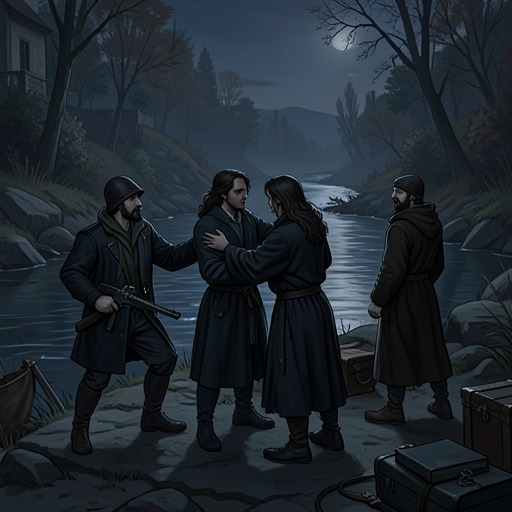
Jaromir encounters an Arachnida nest while carrying out a paid contract with his brother Damir. The task itself is a minor land dispute: they are hired to burn a garden whose ownership has become entangled in a magistrate's ruling about squatter's rights. Jaromir does not truly need Damir's assistance, but Damir refuses to accept money without working for it, and his pregnant wife is expecting twins and needs whatever additional income the contract can provide.
The nest transforms that low-level piece of paid work into a family tragedy. Damir takes a barb to the heart and dies before Jaromir can return him to town. The death gives Arachnida a central place in Jaromir's survivor's guilt: Damir was not pursuing glory or seeking a dangerous adventure, but trying to earn money for his pregnant wife and unborn children. The creatures thus become inseparable from Jaromir's memory of pride, responsibility, and the terrible cost of an apparently easy contract.
When Jaromir recounts what happened, his breathing quickens and takes on a desperate edge. The physical response shows that the nest remains an active wound rather than a settled anecdote. His grief is not abstract history; it is carried in the body whenever the circumstances are remembered.
The Nest Encounter
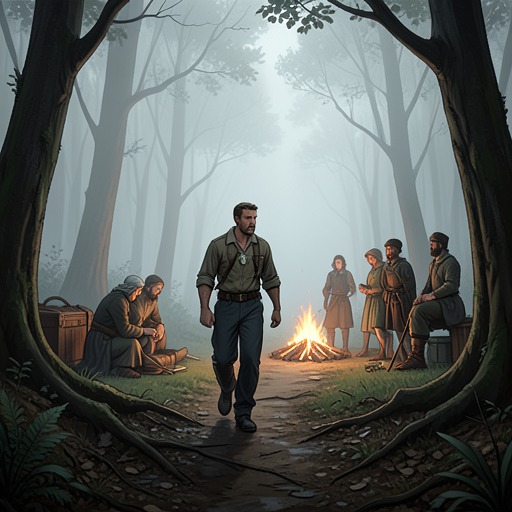
Later, the expedition reaches the edge of a forest and encounters what appears to be another Arachnida nest. Before the creatures are fully understood, the scene announces their presence through the pestilential smell of rotting flesh filtering through a scarf. The narrator experiences nausea and the onset of panic, while Cadoc speaks from a distance as the narrator struggles not to tremble.
The visible beasts are mottled gray and almost humanoid in appearance, but they prowl on all fours. They pick over remains, and two fight one another for what appears to be a deer carcass. Their large, jagged teeth and sloe-black eyes make them resemble the monsters of frightening children's tales. The encounter moves from anticipation to revelation: an unseen nest is first inferred through smell and dread, then made horrifyingly concrete by the creatures' bodies, feeding behavior, and competition over carrion.
The episode also shows that Arachnida threaten a group psychologically before they attack it physically. Fear interrupts speech, produces nausea, and narrows attention around the grotesque spectacle of the nest. The narrator's reaction contrasts with Cadoc's attempt to identify what they are seeing, emphasizing the difference between practical recognition and the paralyzing shock of encountering a legendary danger in reality.
Ecological and Historical Context
Arachnida belong to a landscape already marked by unequal danger. The later nest is encountered amid rotting flesh and animal remains, making the creatures part of a predatory environment where death is visible and contested. Their infestation of Death Valley likewise frames them as a persistent hazard associated with ruined or marginal spaces rather than as a single isolated monster.
Their danger is repeatedly placed beside older political violence. In the history of Targgein, the alliance of Hawthok and human forces during The Unification, also remembered among elves as The Great Loss, produced rewards for dwarves who fought: land and minor titles. The same historical order preserved human and dwarven accounts as heroic narratives against ancient elves, while elven texts and sacred structures were destroyed. Arachnida are not agents of that persecution, but their nests occupy the same world in which land, memory, and safety have been violently redistributed.
This parallel sharpens the creatures' significance. A nest is a place that cannot be safely claimed merely by official language, contracts, or magistrates' decisions, just as land disputes and anti-elf laws turn belonging into a question controlled by power. Damir's death begins with a human property quarrel and ends in an encounter with a nonhuman territorial danger; the juxtaposition exposes how fragile legal and economic arrangements become when they meet the physical world.
Narrative Significance
The Arachnida serve as recurring threshold creatures. They mark the point at which a journey leaves the manageable realm of plans and enters a space governed by instinct, territory, and bodily vulnerability. In Damir's story, the nest destroys the expectation that easy money can remain easy. In the forest encounter, it converts rumors into immediate horror and forces the expedition to confront what had previously belonged to frightening tales.
Their most important consequence is relational. The creatures cause Damir's death, deepen Jaromir's survivor's guilt, and later provoke panic in the narrator, so their appearances reverberate through family bonds and expeditionary trust. They are therefore more than obstacles to be defeated: they are reminders that danger can arrive without moral explanation, that ordinary labor may carry fatal risks, and that crossing into another creature's territory can expose the limits of human control.